


Episode Transcript
Gary Hoberman
Welcome. I’m Gary Hoberman, CEO and founder of Unqork.
Dave Ferrucci
Hi. Dave Ferrucci, chief technology officer and chief AI officer at Unqork.
Gary Hoberman
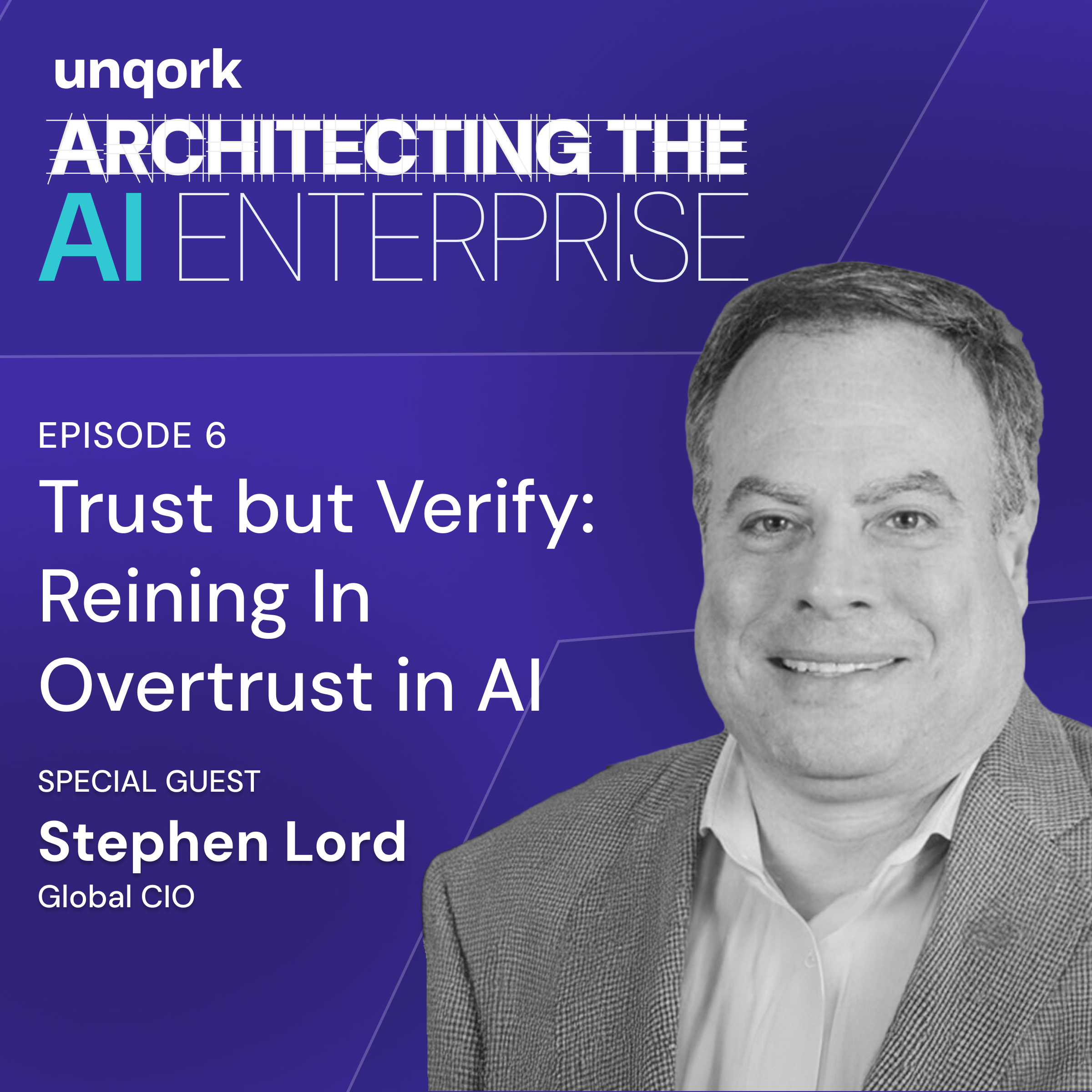
Yeah. We can’t forget that, Dave. We gotta make sure. We gotta keep adding to it. And, in this series, you know, architecting the AI enterprise, we bring on top technology leaders, talk about what’s real, what’s happening, what’s what’s the future look like in their mind. Of course, all the disclaimers will put that we can’t predict the future, but we do our best to try. And with that today, I’ve got a friend, colleague, partner, like this is someone who I’ve known a long time as Steve Lord, Global CEO of Axis Capital.
Welcome.
Stephen Lord
Thank you. Thank you. I’m glad to be here.
Gary Hoberman
So so, Steve, like, I knew Axis Capital when the CIO was on the board with us back when I was a MetLife CIO.
You have to give the audience, like, a little bit of snapshot. Like, what is Axis?
Your new CEO is amazing. Like, I I look at CEOs, and I look at, like, the caliber out there, and he’s definitely up there as far as vision goes. Please share a little bit more.
Stephen Lord
Yeah. So we’re we’re a a commercial insurer. We so we specialty risks, these are complex commercial risks, and we write both insurance as well as reinsurance, where we’re providing insurance to other insurance carriers. And we do this both in the US and Canada, in North America, as well as internationally. So we have an entire global markets unit.
So our risks run the gamut of of things that would be more interesting than your average Could you give us sense
Gary Hoberman
like, what would be one craziest risk that you think
Stephen Lord
Like, when the ship hit the Baltimore Bridge and it collapsed, that is our loss.
When I’m sorry. When somebody put put a missile into a ship docking at the United Arab Emirates in the Strait of Hormuz, that’s us.
So these are and we do we do directors and officers for public corporation. I mean, we do it’s really a very wide gamut Cyber.
Gary Hoberman
Cyber insurance.
Stephen Lord
Cyber, of course, all forms of marine, the actual ships, their cargo, the liability, you name it. So this is this is this is not mayhem or flow from Progressive.
Gary Hoberman
I I can’t imagine being the underwriter that looked at that and, you know, oh, yeah.
That chip’s not how do you decide if it’s gonna hit
Stephen Lord
There’s a reason our stock goes up and down lately.
Yes. And Yeah. It has to do with whatever’s coming across the news that day.
Gary Hoberman
That’s pretty amazing. And just give us a little background how you got to the global CEO position because think we first met at Hartford, I think it was, but please No.
Stephen Lord
Actually, you know, we actually met my first go around at Axis Oh. When I was working.
I I have had multiple roles in Axis, I’m a returning
Gary Hoberman
Highly.
Employee. Yeah.
Stephen Lord
So you and I met, I think, a decade ago.
And at that time, I was running the reinsurance IT unit, and I was the CTO of the company. And then I I did leave, and I ended up at a company called Navigators.
It’s very similar to Axis in that it’s a specialty insurer and reinsurer
Gary Hoberman
Yes.
Stephen Lord
Which was acquired by The Hartford.
And then I had multiple roles at The Hartford, and then returned to Axis when they were when they had a CIO transition with Vince when Vince Tizzio came in as CEO, it kind of was a was a change for the company strategically.
And I had worked with Vince, both at Navigators and at The Hartford, and so I was thrilled to come back and really have a chance to to, witness the company’s almost rebirth rebirth, under the new leader.
Gary Hoberman
I’ve gotten to meet Vince a few times. He has a vision, and I love that there’s no title like seniority. Like, you don’t feel he feels like he’s just one of the guys you’re talking to, and it’s just very easy.
Stephen Lord
Yes. He’s he’s very down to earth, very direct, and he’s very driven. Yes. And so he’s not he’s not in this for any reason other than to succeed.
Gary Hoberman
That’s awesome.
And by the way, before even then, when we first met back at Axis Capital version one, which is amazing, technology background, what was your what was so CTO, you had to have a technical background
Stephen Lord
for that.
Yeah. I mean, me, personally, I I started out in consulting, doing systems integration consulting, writing code for many years, and I was I had even worked for a for a college professor who shipped a logistics product in the years before Google Maps. Truckers needed software to plot routes across the country, so that’s where I first cut my teeth that kind of doing enterprise software development for him and was in consulting for more than a decade.
Gary Hoberman
Wow. That’s definitely optimization challenge, Garth. That’s And that’s what it was. So so getting right into it, like, so AI has definitely changed the world.
Like, we we see it. It’s exciting day in and day out. And every day, there’s some new announcement you didn’t you couldn’t predict. It’s kinda like the bone hitting the the verge in some ways.
What are your views right now? What do you see happening within Axis? And what’s I’m curious to see, like, what’s what’s active?
Stephen Lord
What’s You know, it’s funny. When when I when you and I were talking about AI a certain number of months ago, and it was a certain number of months ago, you you you were very, very enthusiastic about its hate possibilities. And I was too, but lately, I’m more I’m I’m catching up to you. I don’t know that I’ll ever quite be as enthusiastic as as as you are of different person, but I I am very, very excited about what its capabilities are. They’ve really turned a corner from what I can see just in the last twelve to eighteen months that have just astonished even me. So I I mean, I think it’s a real amazing opportunity to boost productivity both inside of inside of technology organizations like the one I lead, but also around it with our colleagues and partners.
Gary Hoberman
Yeah. I mean, I Dave likes I guess, Dave, your expression is it’s we both what is it you say? You both underestimate it overestimate it.
Dave Ferrucci
We we both tend to over and underestimate it at the same time. And, you know, I mean, I think sometimes we we overestimate it when we look at it as an oracle with the absolute correct answer to anything. And I think we underestimated to your point, Steve, about how much of a productivity gain you can realize if you kind of know how to use it, know how to interact with it, help you formulate hypotheses, help you research, answer questions, and formulate ideas and work products. But you know, you’re really engaged with it. It’s very different than going over giving a prompt and saying and then handing that to your boss or something like that. And so, we underestimate in how much we can improve not just the speed at which we do things but the quality in which we do things if we in fact, you look at it as like a thought partner as opposed to, you know, a crystal ball or something.
Gary Hoberman
It’s kind of funny. This this week, I was playing with the latest AI that we’ve been working with here.
And, you know, Rich is in the room with us here who’s our chief evangelist head of SALS, and I posted something in the group going, you know, I think something happened because it’s suddenly talking to me. The the AI is talking to me in in what I thought was Chinese, Mandarin.
And it just started doing and I’m like, and I don’t speak Mandarin, I don’t know it. And Rich was like, actually, it’s Korean, and it’s cursing you out.
So so Dave’s point was, could you imagine giving access to that to do trades or doing something like that at that level? It’s not ready yet, but, you know, it’s interesting.
So in the specialty market, like, the insuring the cargo ships, like, it could potentially look at ideas and help the underwriter think through
Stephen Lord
Oh, god.
Gary Hoberman
You’re Like Yeah. Here’s all the things it knows about that area that maybe they didn’t think of and I see.
Stephen Lord
I the the phrase I’ve been I’ve been using lately is we’re trying to move from automation to augmentation.
You know, for an underwriter, the benefits are plain. They the the ability and it’s it’s kind of has a similar potential impact to anything where there’s kind of a a niche or specialty skill set involved. Like, it will it can augment you in a way where, hey. I I’ve compared this risk to all the other risks of this type that we’ve written.
Here’s the here’s an instant portfolio of how those have performed. Here are the the telltales, the giveaways that have that have been correlated this way or that way. So as an underwriter, you’re starting out from the very first minute turbocharged in a way that would have taken you a lot of personal effort, and you have to be on your game to make sure that you do all of that. It’s all possible to do.
Certain cases, it’s just so difficult that it’s not feasible to do. Yes.
Gary Hoberman
And it’s not feasible to your you know, when you first reengaged with us, when you came back to Axis, you brought your chief architect. Like, that’s what’s your role of architecture?
How do you view his role in
Stephen Lord
the global So I’ve I’ve personally acted in many of the roles of a technology professional.
And so arc to me, architecture is absolutely critical, but often overlooked by by by Agreed. By the by various players in the ecosystem, people who are just wanting to build things, people who are just concerned about cost. Whereas I’m like, if you’re gonna invest a a significant amount of money, say, building a house, no one would ever think to to build a house without an architect. That will just we know it involves floors and walls and and plumbing. We’ll just get started, and we’ll just keep altering it as we go. We you know what kind of a house you’d end up with.
So I’m a very, very strong proponent of
Gary Hoberman
I don’t know why I pictured doctor Seuss, the houses in doctor Seuss.
Stephen Lord
It would end up like that. It would look like a shanty town type of thing. Lorax.
So to me, architecture, when you’re make investing the kind of funds that you’re investing typically in enterprise IT for a growing enterprise, you wanna make sure that that to the extent possible, have both you wanna cover all the the isms or the the iddies that architecture does scalability, extensibility, performance, and so forth.
Gary Hoberman
You know, it’s funny. The ilities is something which most people don’t understand unless you’re leading technology. You’re managing it, like, all the ilities.
Yeah. No. That’s that’s it is critical. I mean, I remember when it was created as a function.
I although recently, I had the experience of it’s smaller than a house, but I wanted to build a barbecue fire pit and, like, fireplace and pizza oven and old brick. And I took a picture of the area, and I told Chattypiti, here’s what I want, and it didn’t. And I said, make it make it architectural plans and drawings.
It did. I gave it to the masonry, and it was about two days later he came back to me and goes, I don’t think that’s accurate.
So I was like like, what do you mean? It looks great.
Stephen Lord
Yeah. We’re still such early days with the capabilities of these tools yet. For people of a certain age that remember, say, the the late nineties, early two thousands, I remember being in consulting when the three g was coming around, and a lot of folks were like, three g is really it’s revolutionary in other when we still had flip phones. In other countries, they were already paying for for vending machines with phones.
Everything’s gonna be on the phone. And, yes, we had wireless. We had mobile. We had the Internet.
But no one was imagining that something like DoorDash was, you know, an entire economy was coming from some of those core capabilities, which took a certain number of years later. And to me, a lot of this still feels like it’s it’s very early day.
It’s still incredible and impressive, but being able to really predict all of the different permutations is a tough If
Gary Hoberman
you were looking at it in terms of education, k through twelve, what grade are we in, do you think?
Stephen Lord
Oh, in the in the in the in the lifespan of of AI, we’re first or second grade at the most, third grade.
Dave, what do you
Gary Hoberman
I’m curious what you think.
I’ve never asked you this. It’s a good question.
It’s a
Dave Ferrucci
I mean, the journey, I I mean, it’s a it’s an interesting question.
I mean, I I are two dimensions to that pop into my mind, which is the the the trajectory we’re on with regard to how to use AI and they’re related and the trajectory for AI itself.
Stephen Lord
Okay. Yeah.
Dave Ferrucci
And AI itself is moving quickly, it’s definitely relative to the last few years slowing down.
I think we’re going to be we’re gonna see continued, you know, to lack of a better word, continued intelligence and capability.
But I think we are further along on that trajectory than we are in figuring out how to even use it effectively and efficiently.
Gary Hoberman
I think
Stephen Lord
we’re really just
Dave Ferrucci
starting.
So if you because if you take the capability we have today, we’re still grappling with what it is, how to integrate it into our business processes, and into our our enterprise systems, even into our personal lives quite quite honestly.
And I think we’re really just scratching the surface on that. We’re scratching the surface of what’s possible. We are adopting the AI and figuring that is the bottleneck.
And and I think there’s also gonna be a positive feedback effect where once AI starts playing a bigger and more appropriate role, that itself is gonna change the entire business process, enterprise operations and implementation, and there’s gonna be a whole another loop that we’re gonna
Gary Hoberman
go through.
Don’t you
Stephen Lord
think, Dave, also, like, the way these these models right now and the the data centers needed to to build them and run them.
Sometimes I think about, like, the early computers that were the size of a room.
Oh, yeah. Yeah.
The form factor is NVIDIA shipping laptop chips for this.
It’s just It’s interesting
Dave Ferrucci
you say that because I I I go around and give general, you know, more general talks to lay audiences on AI all the time.
I love doing that because I love shocking them. And now, I bring up and I talk to, you know, GPT or whatever live and it’s so interesting that the response I get, you know, from the, you know, from the audience is just in terms of how I use it is shocking to them.
Because I think the common way is to almost use it like a search system. And when they see me arguing with it, debating it, telling it it’s bias and to remove its bias and to use these sources and not those sources, And they look at me commanding it in a completely different way and I get comments like, you’re changing my life. But one Yeah. But one of the things that I open up with and to your point was I compare the Antioch nineteen forty six with the iPhone sixteen.
The Eniac was five hundred floating point operations per second. The iPhone sixteen is thirty five trillion.
Stephen Lord
Some insanity like that.
And it and it fits in your hand, you
Gary Hoberman
can take
Stephen Lord
take it with you and everyone’s got their own NES It’s in your time to billion.
Dave Ferrucci
I go through all the stats, but I I end with this stat. A computation that would take a second today would take twenty five hundred years to compute on the ENIAC eighty years ago, you know, nineteen forty
Stephen Lord
And so back in nineteen forty six with ENIAC, was it even I don’t even know if science fiction of that era really contemplated what would be when the form factor and the cost per per calculation dropped by so many orders of magnitude.
Dave Ferrucci
So I think you’re gonna see something. You’re gonna see that trajectory. I don’t know exactly what curve it’ll follow, but I believe the cost will come down not not just because we’re gonna continue to optimize the algorithms, but we’re gonna compile and compress the data.
There’s gonna be all different ways in which to create and generate smaller models. I think the actual hardware for the inference systems at least and probably the training systems will get more and more efficient.
So you’re gonna you’re gonna see that curve.
I think there’s interesting economics around it though that might slow that progress down because there’s so much overinvestment right up front. Right? I mean, buying. In other words, there was a massive investment in the scale and efficiency of a point in time.
Stephen Lord
Yeah. Know what I think about a lot, Dave, is the again, I go back to what I know.
When the Internet era started, there was tons of dark fiber. Nobody could imagine how would we generate enough traffic to fill all this fiber. We figured it out. And then also, when laptops became big, Intel pivoted their whole strategy to be power efficient Yes.
And actually switched their own architectures to chips that were insanely power efficient. When it was a desktop, nobody cared. It said, as long as it didn’t melt how much power it used, They flipped their holes. Oh, yeah.
They flipped to their and now all the chips we use today are designed to be power efficient.
And we haven’t even we we we barely even begun discussing those kinds of
Dave Ferrucci
chips Correct.
Exactly.
Stephen Lord
For AI. Exactly. It’ll take a certain number of years minimum, I imagine. So, like and what will that mean when when those curve those those Moore’s law like curves start to come into We don’t know. Correct. We don’t know. I just know there’ll be a lot more of it.
Dave Ferrucci
Yeah.
I mean, and and and
Gary Hoberman
I think AI what I heard was when AI takes over the physical shape of robots, they’re gonna come after Dave before me and you because he’s been arguing with
Stephen Lord
I can’t wait for the robot that can do laundry.
Okay?
Dave Ferrucci
I I I don’t know. I don’t know. They may think the rest of you are a bunch of saps and they might have hired me.
I don’t I
Stephen Lord
don’t know.
If I I’m happy to I’m happy to be a slave in that army, dude.
Gary Hoberman
I I like it. It’s good. I it is it is a crazy world to predict. It’s gonna be impossible.
Look. Okay. IT function. Yeah. Five years. Where do you think? What what do you think the function’s gonna be?
Stephen Lord
I see. You know, I was talking about this with some of the team. I think there’s always been the kind of there’s been role specialization. I’m an analyst. I’m a I’m a developer. I’m an architect. Yep.
I’m a manager, project manager in certain in certain modalities. But there’s also some people who can do multiples of those things at once and with my sometimes you call them the ten x person or the rock star or whatever. And I think you’re gonna see a lot more of the of the less specialization and more need for all of those skills in the folks that will be working with these types of AI powered augmentation alongside them, to generate good outputs and outcomes, at least at least for the next five years. I don’t know after they always say you can overestimate what’ll happen in two and underestimate in ten.
Five’s right in the middle of that. So that’s certainly moving faster than I’ve ever seen.
Gary Hoberman
You know, we heard it recently from a bank CIO, and they said they’re only hiring senior engineers now because they need engineers that could review the code being produced. Telling it what to build. Right?
Stephen Lord
Like, so you have it’s not so easy to underwrite an oceangoing vessel and understand the complexities Yes. Of the business process. And if you just walk in off the street and you might know perfectly how to guide AI and code generation, but you still have to know what you’re building and for what. And and it’s gonna be a long time before all of the existing sys I mean, I was a systems integration engineer for ten years or more, and I the work was connecting systems together in ways the interface is not the issue, is making sure that they all work together smoothly day in and day out. And this these are whole new levels of problems beyond generating good architecturally sound code, which now becomes almost an afterthought.
Dave Ferrucci
Yeah. In fact in fact, you know, that I I was recently reading some, you know, estimates on this stuff and again, take it with a grain of salt because no one really knows. But they were saying that that ratio of how much of a benefit you get with, for example, AI helping you write code and if you break it up into simple applications, meeting super complex with thousands of function points and integrations and so forth and so on.
And obviously, as a result, larger human teams that it’s a simple app, you know, you’re cutting you’re you’re you’re cutting it in half.
It you know, you’re sitting there with one or two people, the AI assistants, they’re moving really really quickly, you’re getting a huge lift. As you go to medium size, that might turn out to twenty twenty five percent and really complex apps is ten to fifteen percent Because most of the hard work as you’re pointing out is not just in writing the code, it’s figuring out what what do we even wanted to do.
Stephen Lord
Right. Define the problem.
Dave Ferrucci
How do we sync up with a million other people?
What are the integration points? What are the it’s all this other stuff that you have to get in sync on, and so the actual coding is just a less of a percentage of the overall effort.
Stephen Lord
Yeah. What I often say, what is the business problem we’re trying to solve? And that comes from decades ago, but it’s the same issue, is what is the process we’re trying to build look like?
And I will say another thing is that while I think development will get faster and cheaper as it already is
Gary Hoberman
Yes.
Stephen Lord
There’s still the people around it that there’s still there’s still a cultural shift going on, you know? There’s still you were saying, Dave, that people are amazed at watching you guide the AI and learning. Like, those are the people that are even fast followers that are are all over this, you know? This Right. This stuff, societally at least, when when grandma is interacting with it without even realizing it, you know, then we’ve kind of crossed the threshold. And we’re not there. We’re far from them.
Gary Hoberman
We’re far from it. I Still it’s mode these days. I mean, Siri Siri’s taken on a lot since the past week, like, I’ve seen the beta update. My sons my sons are all in AI, so I watch them play. They’re interacting with Siri now the way I never thought they would be able to, and it has access to all of their data on the device, which is fascinating to think they’re not thinking twice about take it all. Yeah. We we’re the old school.
They used
Stephen Lord
to say digital natives, and now they’re AI natives.
AI natives. It’s a There’s still all the rest of us here.
There’s still
Gary Hoberman
can I ask on in a process inside of Ax, is there a place today you could say, you’re comfortable putting an agent here to act Yeah?
Independent, without human in the loop, without review?
Is there any place today or
Stephen Lord
where Internal things, you know, internal things where the the agent the barrier is the actions that it can take in making its own decisions.
And so in in in insurance in general you know, so underwriters let’s just pick underwriters, even claims professionals are conservative by nature. If you underwrite the wrong risk Yes. And that ship sinks, you just took, you know, a billion dollar loss type of thing. You know?
Yes. So there’s an inherent conservatism. And then we’re a regulated industry, so you’re not gonna let an agent, There’s always gonna be human in the loop for something that is transactional, financial, underwriting decisions of of significance Yeah. Claims handling.
I’d see a lot of agents that are more kind of informational, inserting agents into the for example, we were just talking about a wonderful idea to use agents to judge architectural compliance for code that’s moving its way through the DevOps pipeline. And that’s something all new. That’s it was just mind blowing to me. Literally was Score the code.
Was never possible. It was never it was never something to think about because it just could not happen. Right. But now it kind of can.
Dave Ferrucci
There there there are a lot of things like that that yeah. Those are fascinating.
It’s just we wouldn’t even try to approach them, you know, with
Gary Hoberman
Yeah.
Dave Ferrucci
With traditional systems, traditional software systems. Yeah, it’s quite interesting.
Stephen Lord
I would never let an agent promote code to production on its own, you know. So anything that’s gonna have a significant downside, just like writing the wrong policy or the wrong limit, you’re gonna want an HITL situation there, governance.
Dave Ferrucci
The human the human in the loop though thing is is interesting. You know, it has, I mean I get it, it has to be there, but it definitely is not the same thing as having the human do the original work. No. It’s just because of, it’s just human cognitive orientation, right? I mean there’s a big difference between me checking someone else’s work versus me doing it. Absolutely. The more I trust that other person, the less work I actually do.
So there’s this risk of learning to generally trust the AI and missing those sorts of errors that have sort of asymmetric risks on your business.
You know, it might be very easy to detect it if you paid attention, And so there really isn’t all that much effort but you end up not doing that effort because you trust it and then it’s just asymmetric because it’s
Stephen Lord
You mean like the people who are reading books behind the wheel, they’re self driving cars.
Dave Ferrucci
Yeah.
Mean, know, and then
Stephen Lord
Instead of watching the road.
Dave Ferrucci
And then something happens. Right? So I I think, you know, and again, we don’t know. We don’t know how this is gonna play out and we need some empirical data. But it, you know, there’s it’s when you as as I think we all know, like, when you do some work yourself, you have a very different intimate relationship what what what went on there.
Stephen Lord
Yeah. Sometimes, I never really paid any attention to human computer interaction Yeah. As a discipline, but you never thought of it. It’s about to get very, very interesting.
Gary Hoberman
It’s interesting because we offshored development years and years ago, and we said, hey, go do this piece, give it back to us. We did let check it in, do code. Like, in reality, we’re trusting it was done well when it’s a human.
You could see it getting there, you know, but I to your point, even if it was creating the code, it still has to be checked before being released.
To think about that’s
Stephen Lord
a good analogy, the offshoring analogy.
Like, the the the proponents of offshoring saw it as a panacea. Yes. Like, we’re just gonna send everything, and it’s gonna be great at whatever fraction of the cost. It didn’t really work out. It definitely was an augmentation. It was an arbitrage. But show me the place that really has completely divorced Have you ever seen them there?
Gary Hoberman
I’m curious because I when I was at Citigroup, we had a captive and the captive was our employees and they were I would say those employees were as strong as my team. When the market fell in the financial crisis, we sold the captive to a very large, you know, offshore firm and we started to see turnover of forty, fifty percent of our employees as they were now part of that consulting company. And I’ll never forget my senior engineers coming to me and going, three to one. I’m like, what do you mean three to one? They’re like, I give you back three of those headcount for one junior person here. And I did it. I said, financially, it makes it’s a wash.
Stephen Lord
It found a new equilibrium, but it was not like a just a set fire and forget solution.
Gary Hoberman
It was not What was your experience? Have you seen it working?
Stephen Lord
And I I’ve only ever heard of the legends of the, you know, the ninety percent outsourced thing, but I only believe that that’s possible under laboratory conditions that don’t exist in a growing company with complex and changing needs, which is all I’ve ever wanted to work in. Like, if you’re working at a runoff insurer, you have different IT needs That’s than one that’s adding products that is overhauling. It’s growing its practices, changing, and there are new forms of of business that are happening all the time. We’re seeing kind of shifts into delegated underwriting. So there’s constantly this is why people love talking to me at cocktail parties because I I’m such a big insurance buff, but there’s a lot of things going on.
Gary Hoberman
Yeah.
Stephen Lord
And that that translates into the need for kind of high food chain intelligence in software development and support too, for that matter.
Gary Hoberman
I’ve never met anyone, Steve, besides you, who will say that they’re the cocktail hour, like, they’re the Oh, yeah. They’re the cocktail hour.
Stephen Lord
All I have to say at the cocktail party is I work in IT for insurance, and somebody needs to get
Gary Hoberman
to the bar and refill their drink immediately.
There was actually a friend of mine. She’s a she’s an author in insurance. She’s she was she’d be brought in to do innovation in companies when I was at MetLife. She was but she used to fly all the time, and I remember she gave me a cover of a book. It was just the cover, and she sold them. And the cover of the book was called, like, the five most interesting things about life insurance, and she would put it around her books that she was actually interested in just so people wouldn’t bother her. You know?
Stephen Lord
Oh, I see. So it’s out of, like, an like a like an amulet to ward off people.
It was
Gary Hoberman
a it was exact she said, when I fly, I wanna be by myself, and that book cover
Stephen Lord
looks good.
That’s one person you don’t wanna start a random conversation.
Gary Hoberman
Maybe we should sell these.
This could be
Dave Ferrucci
a good thing.
Life insurance.
Gary Hoberman
But, I mean, specialty insurance is a lot more interesting than life insurance.
Stephen Lord
Yes, is. But anyway, obviously, those anecdotes, which are real, they’re like I said, they’re I do it with my daughters. Although, I say, let’s watch television. Like, every other commercial is an insurance commercial. They that most incredible marketing on the personal line stuff because they have to differentiate, but commercial is a little different. Most most most average people aren’t buying a, you know, side a directors and officers policy because you’re on a board of a fortune fifty Correct.
Gary Hoberman
Types of thing. Correct. That’s wow. That’s okay. So let’s go through it. I think is there any other questions, Dave, on your side?
Otherwise, we’ll go into lightning round if we’re we’re almost ready for that. Let’s see.
Dave Ferrucci
I’m I’m good. Let’s do it.
Gary Hoberman
You wanna you wanna do the first lightning? You’re gonna go first this time.
I always
Stephen Lord
go first.
Come on.
Dave Ferrucci
I I I always love to ask, you know, what you’ve been binge watched recently or what you or what you think is really good.
Stephen Lord
You know, there’s a couple of things that that I’ve been burning through. One is your friends and neighbors Yep. Which is a grugger show. So this kind of show is kinda like almost a cinema, almost verite of life in lower Southern Westchester County where I live.
So you know what?
Gary Hoberman
I’m moving in near you. Coming to arrive in a few weeks.
Stephen Lord
Okay. So So it’s this is a little bit exaggerated, but it’s filmed in the area, and so it’s it’s riveting. I like the actors, so I enjoy I enjoy that show. And then I’ve been watching I’ve been I’ve just picked up Widow’s Bay, which is which is a comedy horror or horror comedy, so to speak, and it’s it’s very subtle and very cute.
Gary Hoberman
I I happen to think Friends and Neighbors is one of the best shows. It is. It is. I actually just though, I’m referencing it like Seinfeld lately.
Yeah. Like, again, I don’t think Seinfeld has ever had a show like it. And for the younger generation, they’re like, what’s Seinfeld? But I use it in all analogies.
We always do.
Give me your favorite book that you’d recommend.
Stephen Lord
So one of the ones book that I personally enjoy, I I do I as the longer I I work professionally, the more I pick up kind of management management tomes and management books. And twenty years ago, everyone was talking about good to great. It’s kind of the origin.
One of the more recent ones is by an author named Liz Wiseman called Multipliers. I don’t know if you’ve heard of it or not, but the concept is around leaders that improve their organizations by mult they’re multiplying the capabilities. And then they’re inverse. They’re doppels doppelgangers are diminishers.
Those that, by their actions and by their characteristics, diminish the the the capabilities of those that they work with. And I thought this was just a something when you read it and you go, yes. This is I I know people. I see these these things, and now I have a a mental framework that neatly encapsulates it, and it’s become a shorthand for me.
Gary Hoberman
I love behavioral economics books. I love yeah. Yeah. This is that’s what that that’s and Dave, with with with Kahneman and Kahneman’s type type. Think fast, think slow.
Dave Ferrucci
And then I also and I love Darriel Ariela. Right? Yes. He’s very good too. Yeah.
Gary Hoberman
Yeah. I mean, I I think it’s fascinating how crazy we actually are.
So well, are we
Stephen Lord
Again, I work in IT, so I was never the soft skills were always the the lesser priority.
Always tell people I went into tech not because I was good at dealing with people, And yet, at this you know, in today’s world of enterprise IT, dealing with people is the job.
Gary Hoberman
It’s the job. It’s all about it. It’s getting Dave, I’m gonna ask you one, which we didn’t, which is are we what’s the probability we’re living in a simulation with that point? When I said people are crazy and we’re talking AI, give it a number.
Dave Ferrucci
I don’t know. I think it’s a very I I think it’s a it’s a it’s a fascinating theory and it’s very hard it’s very hard to argue that it’s it’s very hard to argue that it’s not plausible.
Just don’t know how to give it. I I’m not sure how to give it a probability.
Stephen Lord
Isn’t that kinda like Pascal’s wager? If you believe in it strongly, what’s the point of anything? You know, like Yeah.
Gary Hoberman
Yeah.
If I
Stephen Lord
It’s kind the inverse of Pascal’s
Gary Hoberman
there’s some kid with pimples that’s controlling me behind the scenes, like, a game, playing sim.
Like, I it’s it’s interesting.
It is a very
Dave Ferrucci
It’s very Yeah.
A very strong, strong analogy. It’s very interesting.
It holds up under so it holds up surprisingly under, like, deep scrutiny. Anyway, it’s who knows?
Gary Hoberman
That’s what they they say eventually with AI, we might find the answer to that. We’ll have to see if we’re but, Steve, this was amazing. Again, like, your leadership and getting to watch and, you know, your whole journey is incredible. And I appreciate you coming here in our office.
You didn’t push a button. You could push a button before we go because we got this new control panel. So let’s just do it. Yeah.
That’s awesome.
Stephen Lord
But it seems appropriate at this point in the in the discussion.
Gary Hoberman
Awesome. Steve, thank you for for being an amazing friend, partner, and and being here with us.
I appreciate the opportunity, and and I’m I will be back for sure. Awesome. Again, and thank you. Thanks, everyone, for watching.
Thanks, Dave, and until next time, architecting AI enterprise. Take care everyone. Thank you. Thank Thank you to our listeners for tuning in.
Make sure to like and subscribe. We hope to see you again in our next episode. Please send ideas for topics or guests that you’d like to hear from. We look forward to seeing you then.
Thanks.