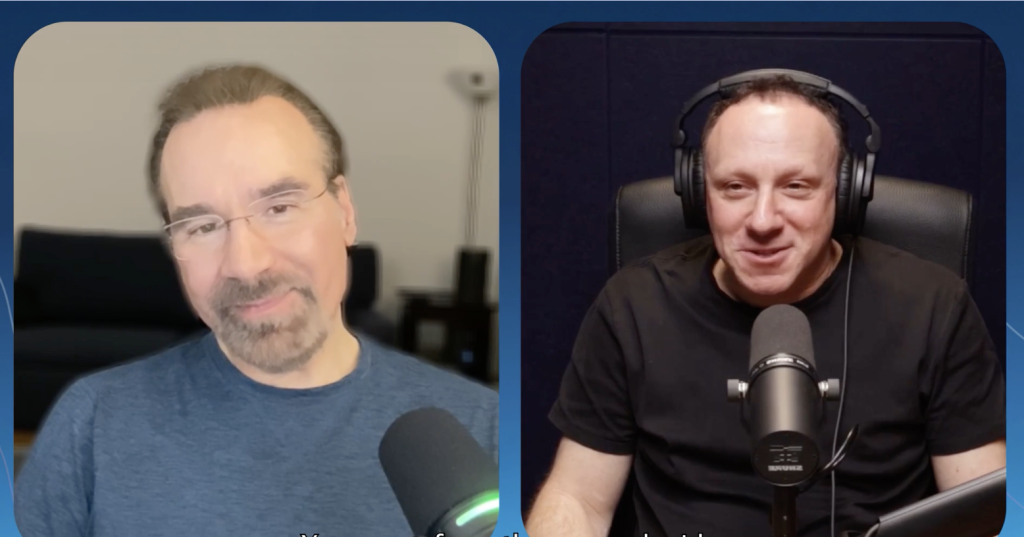





Episode Transcript
Gary Hoberman
Hi. I’m Gary Hoberman, CEO, founder, Uncork.
Dave Ferrucci
Dave Ferrucci, chief AI officer and CTO at Uncork, longtime AI researcher.
Gary Hoberman
Thanks for joining us again. In this series, we’re going to be exploring architecting the AI enterprise. What does AI truly mean? How is it being deployed? What do we think the future holds as best as we can predict it? And today, we have a really exciting guest with us.
Ala Whitston is the CIO for MUFG Americas. And, Ala, I got to see you on stage at, a AI event in New York City, which is where we met. But, you know, first thing I wanna start with is just, like, when I was an engineer, I wanted to be CIO. That was the goal.
There was a there was, like, how is the path to get there, the career road map? And in many cases, it sounds like the, the Odyssey book, the hero’s journey. It’s like, what’s the story to get there? So first off, if you could introduce yourself if and what’s the journey that got you to where you are today?
Alla Whitston
K. Well, first of all, thank you for having me here.
It’s really actually, I’m looking forward to this conversation because we talk about AI all the time, but we rarely focus or refocus ourselves AI for enterprise because the journey and the story is very, very different. So now about my story.
No. I never thought that I wanted to be a CIO. What I always wanted is to be a technologist. Yes. Solve problems. And then when I actually learn how to solve problems through technology, I decided I wanna solve problems through technology for the business. And the journey to CIO, I think it was more along the line. I wanted to solve problem.
I only, as an application developer or infrastructure architect, only can touch and influence portion of, and getting frustrated about not being able to really embrace and think about system and architecture design, specifically for business enablement.
So my journey to CIO was, let me figure out how I’m going to actually get to the point in my career that I can talk to business, understand what they want, how to drive the revenue, how to be trusted by them so we can implement technology to enhance their productivity, enhance their product and services.
And the best way to do it is to become a CIO.
Gary Hoberman
That’s amazing. So you wanted to learn the business. I always used to tell my technology team, you should learn the business and know the business better than the business. So that’s what you believe is basically just understand the problem to solve first.
Alla Whitston
Absolutely. Every single time. And I think as we start talking about AI, bringing it back, how AI is actually going to help business and how is that knowledge by the technologists is becomes will become one of the most important one of the most important, actually, qualifications to be successful in this evolve evolution of our technology field.
I really believe that is going to be critical.
Gary Hoberman
That’s amazing. With that said, like, you oh, that’s amazing. So you learned the business, which helped you gain more knowledge in technology, how to apply it to the business. It’s a circle. It keeps going up and infinite till you get to the point of CIO.
Alla Whitston
Absolutely. I mean, the business wants people in technology roles who understand what they do. So when we as a technologist get to the table and we speak only our own language, we really don’t reach them. We really don’t build the trust with them because we speak a language they don’t understand. You have to figure out how to actually reverse that.
How to get to actually say, I know how your process works.
I’ve been there probably five years ago when we designed it in the first place. I know where your shortcomings are. I know now with the new technology, I can do so much more. What do you think about that?
CIS right now at the table, sitting at the ECA tables, we talk about growth. We talk about product and services. We are part of the organizations who approve product and services.
So we’re not just being brought to the table to decide how do we improve in the in world, old world? How do we design application to do x, y, and z? Like, what can we do to compete?
Gary Hoberman
That’s gotta ask the word architecture. So it’s part of a is there a business architecture function that’s equivalent to your technical function, and how is technical architecture work?
Alla Whitston
So that’s a brilliant question. I don’t think we ever called that business architecture function, but what we really called in very mature organizations, business organization, is the product.
So a chief product officer, you know, in my ideal world, lives within business.
And those products and services architected by the people who live within the business report to the head of business are actually the architects, business architects.
Gary Hoberman
I like that. That’s you know? And do you actually have product managers? You have product owners? You have that that role within the business today?
Alla Whitston
We have some of them. We I worked in the previous places, previous organization that was more mature than in others. So I think that’s kind of the evolving field, but I think it’s gonna gain so much more right now with AI coming to the table. Well, we don’t need to really talk about BRDs at the granular level. We need talk about business architecture, business workflow, business products.
Gary Hoberman
The outcomes.
Alla Whitston
Absolutely.
Gary Hoberman
That is so I’ve seen outside in now as a vendor selling into customers when they don’t have a product owner, the product officer, and they have a program manager, the outcome is not the same. So the product owner, from what I’ve seen, the product manager role, they have a date to get something done by that’s meaningful. Yes. And they push the date. They push for that date. That’s is that similar to what?
Alla Whitston
Absolutely. It’s it’s it’s not just the date. Date is irrelevant. I mean, I always talk about the date being irrelevant. It’s working with the client and making sure that clients are ready to take the product and services that you’re just developed or you’re delivering and knowing why would they be willing to change.
When I worked very, very closely, when I worked very closely with the product architecturally, let’s say, on the business side Yes. The biggest conversation, it’s not about how do we develop. The biggest conversation is how do we entice our clients to test what we are delivering and then adapt it.
Because they live with that, or they live without that, or they live with the similar product and service by someone else. What is our comparative edge to actually ensure that our products were actually going to be used?
Gary Hoberman
So what you’re describing, there’s there’s always the concept of the CIO as the service partner slash order taker versus the business partner. And you are definitely on the business partner model.
That is when it comes to budgeting Do you sit with the business and budget for the projects and say, here’s what we should be investing?
Alla Whitston
Absolutely. I mean, again, we sit with the business. They they come to the table saying, wanted to invest in this. Like, okay. Go ahead. Go get the money. Then we sit with the business and with them, we talk about, did you really mean that that’s what you wanted to invest? How about we invest in something else?
Gary Hoberman
And you do that’s amazing. That is and that shows true partnership. That’s that’s a very unique level. I don’t see that in all the places I’ve we’ve we’ve worked with, and that’s that’s amazing. Technical architecture. Yes. Is it a function in your group?
Alla Whitston
It is a function in my group.
Gary Hoberman
Yes. What do they do?
What’s their roles do you take?
Alla Whitston
Really good question. So technical architecture in my world, so they’re solutions architects, specifically aligned with business products.
So they understand the business end to end. They understand workflow. They understand what is available on the market.
What are the comparative products on the markets from the business standpoint as well from the technology.
Gary Hoberman
Wow.
Alla Whitston
So those are the solutions architects. So they if the good ones will know that, then they will develop the strategy for the several years. Like, in a bank that I work, we do the strategy for a year as well as we operate in a three year cycles.
And we design our budgets and everything else in three year cycles. So our, like, next third year starts planning starts in August. So in January, we built the strategy for twenty six. I mean, whatever we continuation of from the previous three years.
And we started working on our three year cycle, and then we will fine tune it with our business and have all the approvals next year for that. So those are solutions. Then we have domain architects that are more on the technology side, cloud, security, network architects. So they ensure that our not just the standards, but our current environment, current architecture is fit for purpose today.
And hopefully, if we are smart enough and we have the right people, then we are fit for the future as well. And where we are not, we kind of move towards that through our strategic plans. Now, don’t wanna paint the perfect picture. You know, some areas we’re good, some areas we’re not.
It’s, you know, it’s it’s like in every organization, you have a strengths and you have challenges that you’re trying to build up, but it’s a critical function. What I haven’t mentioned is application architecture.
That is probably for, in my organization, is right now the weakest point because it is within the tower of, let’s say, CIO for commercial bank or the CIO for enterprise functions.
Ideally, you have application architecture and application platform across, and it’s standardized. And in a really mature organization that I had a privilege of working, you have a global application standards for the both infrastructure products applications, as well as the business applications. And they’re all connect, they all integrate, and they all work together, long term and short term. So we are working towards that.
AI is helping, and it’s gonna help significantly more in that journey.
Gary Hoberman
I’m curious, like and if you can’t share, don’t worry. But, like, number of applications, it’s because, like, people don’t when I when you think about a bank, you might say, yeah, thirty, forty applications to run the bank. What number of applications do you have within the group, would you say?
Alla Whitston
So let’s say let’s let’s just take subset, Commercial Bank Americas. We are right now around six hundred applications.
Gary Hoberman
For just the commercial bank?
Alla Whitston
Just for Commercial Bank. And we were about eight hundred fifty, so we decommissioned about two fifty over the course of last three years.
Gary Hoberman
You do a buy hold sell analysis, and you say which applications are we gonna get rid of, and which ones we’re gonna invest.
Alla Whitston
We had a long conversation with our actually, you you know, I work for MUFG, so at the home office, who is responsible for the life cycle of the application, especially making decision hold, sell Yes. End of life, end of service. And there was a thought of some of our leaders that that role belongs in a business.
And actually, I don’t agree.
Gary Hoberman
Yeah. I don’t agree either.
Alla Whitston
Alright. Thank you. So we we both know what’s gonna happen if business will decide if application stays or goes, maintains upgrades, and so on and so on and so forth. It’s not gonna happen. I mean, it’s not gonna happen in necessarily the right way.
Gary Hoberman
Hundred percent.
Alla Whitston
So we had a long conversation that felt that business will be able to invest smartly and allocate money, funds, time, because, right, old fashioned way, UAT testing, and all of those fun things where you need business engagement. So subsequently, they need to drive this. My point is no. We need to partner when they can influence. They have to be part of the conversation. We always want them to be part of that conversation on ongoing basis, tactically and strategically, but they cannot possibly own.
And that’s when it comes to the application architecture and application life cycle.
Especially right now with the direction we’re going with AI, that’s becoming more and more, much more elevated decision, much more strategic and consequential than anything else that we probably were doing before.
Gary Hoberman
I like so it’s domain architects, solution architects, and application architects, which I haven’t heard the third. So that’s something new for us.
Alla Whitston
Well, application platform. Right? If we think about it, especially as we get through the AI coding. Yep. One of the biggest fears that probably I have and a lot of my peers, and I’m sure you would have, is how decentralized in AI coding world it’s it’s going to be if you allow that compartmentalize, decentralized, because you’re going to have anyone and everyone rightfully so, including citizen development, developing applications. So what guardrails are we going to have? How do we stop?
And I don’t wanna stop anyone. I wanna enable everyone, but I just wanted to have a right guardrails Yes. Around that. And for that, you need application architecture.
You need application standardized application platform, almost like a plug and play. Go develop your thing. I’ll give you the template format guardrails. Then you can plug in into my AI platform, and it’s going to just work because you followed all those standards, and including security standards, including identity and access management standards for humans as well as for agents.
Gary Hoberman
The agent should be treated like a human in a company. What entitlements do you have in software? What’s your permissions execute services? What’s your audit trail and tracking?
All of that is the same thing as a person. Yes. Should be no different. You know, it’s interesting.
So so Dave, like so when Dave came into on Quark, he said, I’m gonna mandate the developers use these coding tools.
Gary Hoberman
We we hope we’re the last group ever using those tools because that’s what our goal would be. But we’ll we’ll get a long journey get there. But we’ll but, Dave, just your experience in the coding tools. I’m curious just to give some perspective what you see. You’ve used them yourself, you said, your garage way before you joined us even.
Dave Ferrucci
Oh, yeah. I mean, I’m, you know, an active user. You know, look, I think they’re incredible. They provide incredible acceleration.
But to the earlier point, where are the guardrails? I think you have everybody creating, creating code much, much more easily. So it’s in some sense, the whole process of writing code has been democratized. It did the access to the ability to take an intent and generate an application or a function that performs an intent is just now available to almost anybody that you give access.
And so the challenge does become all the things we hear about, code sprawl, code draft, things getting out of sync, tremendous amount of redundancy, not just redundancy in intent, but in methodology. You know, you’re doing it that way, know, one person gets it done that way, another person has a different intent that gets done a little bit differently.
So you now you have a lot of replication, different implementations for no good reason.
Look, think that the interesting thing about architecture is architecture is about constraints. It’s about governance. It’s about, you know, putting rules and constraints on top of the process of coding so that over time, maintenance and management are possible. Like one of the, as an architect, you sit there and one of the first questions you ask is what changes together and what changes independently?
And you define interfaces and modules based on your understanding of how things change. But how things change is not something that comes from the code. It comes from the external environment.
And often you have to make bets about how will the technology change, how will the business change, how will the role of humans and technology change as things evolve, how will performance requirements change. You talk about application and technical architecture, right? One deals with function, one deals with non functional things like performance and scale.
Gary Hoberman
So one of the interesting things, you know, when you were going through the various kinds of architects, which I agreed with, one of the interesting things is where do they intersect?
Exactly, and so now this notion of how does the business architect role interface or intersect with the solution architecture, with the application architecture, with the technical architecture.
And I think the reality, these are big decisions that these folks make enormous trade offs. There’s a lot of deep knowledge. It’s not about the generation of the code. It’s about the accountable human who’s gonna make a decision, who’s gonna choose some point in that complex space of trade offs that is going to determine what your long term costs are going to be and what your long term capability is going to be.
Those are tough decisions that have to be made insightfully with a sense of accountability and trust. So it’s very interesting to think about, hey, how AI helps with that. How it might bridge and support the understanding and execution, especially where the intersection of all those architectures are.
Alla Whitston
I think what you described, all the fears associated with the change, with the maintenance, with the decision making, it’s a hundred percent relevant and costly and impactful to the business in a way we have operated for the last twenty five, thirty years.
We thought we’re gonna have a little bit of reprieve from all those pain points when we went to the cloud and we said it’s elastic, it can go up and down sideways and everything else. We got a little reprieve. We didn’t really get that much reprieve from that. But I think that from the architectural standpoint and how we think about it, as far as the opportunities in the next not twenty four months, I’m talking about three to five years, I think it’s going to drastically change.
So change itself, we’re gonna be significantly less scary than what I think we are right now in all of our worlds perceive it every single day. Right? This whole notion of the change management, change record, every time we something breaks, what did we change? That’s the first question we ask. Right?
Dave Ferrucci
That’s such a key point. I think that’s an important thing to realize.
That’s such an important thing to realize what you just said in the role of AI, right? Architectural decisions are hard and their impact is absolutely dramatic.
The wrong architecture can bring you down very easily, can be extremely costly. It gets calcified over time, it gets very difficult to change, customers become rely on it, and it could have fundamental flaws would slow down the business. So very often what happens, and I’ve seen this over and over again, is that to make a big architectural change is very hard. And I think that it’s very, it’s even very hard because there’s such a commitment to these architectural decisions.
It’s very hard even to get people to open their mind about making those changes.
And I think that with AI, what happens is you can experiment much more rapidly with different architectures. And the speed at which you can convince people to change, it changes. It’s faster. That’s dramatic. That to me, that’s dramatic for the business.
Gary Hoberman
But what percent I gotta ask. What percent of error is allowable within a bank like MUFG? You know? Because these technologies are are probabilistic.
Alla Whitston
Yes. I with AI, specifically with AI, let’s not just idolize AI. Right? I think this is really, really important because there is a significant risks, and we don’t even know how to deal with those risks yet systematically.
I don’t even define them yet. But as far as the errors, when it we are a financial institution. So with the customer, shareholder, financial transaction, there is a zero tolerance for the errors.
Gary Hoberman
You have the regulators. Worked with the OCC. Have them all.
Alla Whitston
Gary, you know it.
Gary Hoberman
And they’re gonna come and say, oh, show me the history of this transaction, and why did you approve that?
Alla Whitston
Absolutely. Everything. So when it comes to our industry, there’s a zero tolerance for the errors.
If we talk about productivity or things like that, yes, of course, humans are not perfect. We’re gonna have some errors. If we have a right guardrails, we have right error handling, hopefully, the right control frameworks, we should be able to catch them before they become systemic and then subsequently spill into our financial transactions.
But the way we think about it is we have so many stakeholders with zero tolerance that I would say it’s close to zero.
Gary Hoberman
So it’s interesting. So your the view of empowering the business, which I love. I love the idea of actually let’s let them build what they need to build, but within our guardrails.
What does the future CIO function look like in your mind in three to five years? What’s is that is it the architecture function?
Or what did they what what does that look like? I’m just curious if you have a vision of that.
Alla Whitston
So as I was thinking about my current in in the current environment, we are a manager of the human capital, human intelligence. I think with AI taking significantly stronger stance in our environments, we become the owners and accountable parties for human and artificial intelligence for the enterprise.
Gary Hoberman
Wow. I like that.
Alla Whitston
So and how do we ensure that both operate properly, human intelligence and artificial intelligence? How do you keep each other accountable for the outcomes, for our customers, shareholders, ourselves, society?
It’s critically important. And I think this role of AI CIO in AI world is going to be increasingly that.
Gary Hoberman
It’s governance. It’s governance.
Alla Whitston
It’s architecture and governance.
Gary Hoberman
It’s the as the line of code comes down to the cost of the electricity that produced it, which is what we’re hearing and we’re seeing and we’re all we ourselves are using, you know, I I like to think that there’s a measurement of what’s the cost of the line of code to maintain maintain once it’s created. You know, that’s the burden. The the I’m using the word liability of that code. Do you think that’s something down the road people will measure?
Alla Whitston
Absolutely. Absolutely. They’re gonna be the measurement of the liability of the code. I think there is already measurement of the liability of AI that we should think about how to embrace.
Liability of AI is from the AI usage today by us, AI usage by our third parties, and AI usage by the companies that we buy specifically for AI models. Yep. So and I don’t think that has been measured enough. I was talking to our chief legal officer yesterday, actually, about that.
Like, how do we think about it?
Dave Ferrucci
Yeah. I let me let me comment on that because I I don’t you know, we wanna be careful to get fooled by sort of superficial error rate counts because I think what you’re looking at too is what is the type of error? Like what it because there’s higher risk errors. Right? So in some sense with a workflow of agents that can compound and amplify an hallucination and depending on how much control you give them over the enterprise or what tools that you give them access to, you can have incredibly asymmetric risks.
So it’s not just about error rate, it’s what’s the nature of the risk that can unfold from that error?
Alla Whitston
Well, we talked about a lot of things, but we have not mentioned is the data.
So models that we buy or create, right, very important, agents that we buy or create. How do we orchestrate those agents? How many do we use autonomous or not? And then it comes to the very, very important portion of it, is our data. So quality of our data, knowing the lineage of data, and subsequently leakage of the data that can happen, and the data that we bring from outside in, or those models that we just bought have been trained.
I don’t think we have thought about it yet enough or formulated what controls as enterprises who we need to enter and build. Maybe large banks to have been doing it for the last ten years, they have it, so I’m not gonna speculate on that. But as I talk to the industry, to my peers, I don’t think we have yet that level of the comprehensive thinking or tooling or understanding end to end and enterprise level. So how to embrace it?
Because we don’t wanna to stop innovation. We don’t wanna slow down innovation.
We can’t. We can’t afford it. I think that single bank or single organization, single company technology or none can actually slow this down.
So the question is, how do we ensure that we minimize eliminate can we eliminate the risk?
Gary Hoberman
We are in the business of risk taking.
Alla Whitston
Right? So we’re not gonna eliminate the risk. But how do we measure the risk and how do we develop our risk appetite in the new world of the AI in all those stripes of the our own agents, our own data, our own models, as well as the external. So we have three stripes that we need to think about. I think it’s incredibly exciting time right now.
Gary Hoberman
Like, I’ll, like, just I think I know the answers. The importance of data models to you and understanding, critical.
How about reuse in the organization? Because there are there are technologists that are publicly stating we should eliminate all open source libraries and let’s just let the AI write the code and just replicate the code for every application. Just keep replicating code.
Alla Whitston
Why?
Gary Hoberman
Good. That’s what I figured you based on what you said, reuse is critical. Does an application exist in the future, or is it just is there there’s a view from some that a database and an app will go away because it’s just an agent?
Alla Whitston
No. I don’t think anything in in a foundation of how we do things is going to going to go away. Absolutely not. I think what is really going away in the software world is how do we interface with software. So we may not write as many GUIs as we are writing today. We may not think about user experience because there will be no user dealing with the vast majority of those workflows.
It’s going to be just API based and agents driving that flow. Just if you think about payments or you think about, I don’t know, lending or trade finance or the trading or whatever it is, rarely the humans are going to be there pushing the button to move the process from point a to point b. Like, why?
Gary Hoberman
How much I’m just curious. From what you’ve seen being in the industry, those processes that move from point a to point b, how much were deterministic that could have been automated without AI had the investments been made?
How much of them is truly probabilistic that need the agent?
Alla Whitston
We probably could have automate close to forty percent, but it’s expensive.
Gary Hoberman
It’s expensive.
Alla Whitston
It’s very, very expensive.
Gary Hoberman
I like that. This is the way to reduce the expense of the automation.
Alla Whitston
Absolutely. We don’t know how to collect tacit knowledge of the individuals.
And we’re really hoping this is one of the biggest advantages upfront of AI is going to be. Fred BRD is sitting down business analyst, writing down how the process works and what if scenarios and how to, if if yes, then no.
AI can just we can AI can teach itself and interact with every single one of those process owners to actually collect that information and then automate the process.
And that’s gonna be truly inexpensive.
Gary Hoberman
That is a really good view. I think about when RPA came out so many moons ago and years ago, the biggest problem I personally saw was not the technology. It was understanding how to automate the process because you have to document it. And then you I remember we were one time deploying it to a team of just five, and all five individuals worked differently.
Alla Whitston
Yes.
Gary Hoberman
It didn’t work.
.
Alla Whitston
Exactly. That’s biggest problem.
Gary Hoberman
We didn’t get the value from it. I’m so, Dave, any last questions from your side? Otherwise, we’re gonna get into speed round.
Dave Ferrucci
Yeah. Let’s go for the speed round. Go ahead.
Gary Hoberman
Okay. So, actually, Dave, you got you asked the first question. I’ll go to the next one. We’ll do this. We’ll alternate.
Dave Ferrucci
Well, you want me to I I think the first I think the first question is what what what is the, show you’ve most recently been watched?
Gary Hoberman
What do you think? Do you know any shows? Yes.
Alla Whitston
Oh, drops of god. Spectacular.
Gary Hoberman
I haven’t seen it. Oh my god. Do I need to just stop everything and go watch
Alla Whitston
And there’s two seasons. Second season just came out. Start from season one and go to the season one. It’s it’s a it’s a beautifully done. It’s artistic. It’s it’s amazing.
Gary Hoberman
What what what is it streaming on?
Alla Whitston
It’s streaming on Apple.
Gary Hoberman
Okay. I’m gonna go why I did not watch that. That’s what app do you use most frequently in the day?
Alla Whitston
Message and communication.
Gary Hoberman
Messaging? Yeah. I think I’m the same there as well. That’s the, the the what was the show last time?
I think I said Landman was the one I was watching last time.
Alla Whitston
Fantastic.
Gary Hoberman
I love it. Good.
Alla Whitston
Yeah. Of course.
Gary Hoberman
Good. Dave, you had a different one.What was the one last time?
Dave Ferrucci
Beast and May. Although, I I I looked at I I started Landman because of your recommendation. Crops of God is about winemaking, isn’t it?
Alla Whitston
Well, there’s more than that.
Dave Ferrucci
Yeah. More than that. I understand. But that’s the yeah.
Alla Whitston
There’s so much more than that. Yeah. If you like artistic movie and that cinematography when it’s really, really good, and then you will like that.
Dave Ferrucci
Yeah. I’m a I’ve I’ve I’ve made I made my own wine for many years, so at least I would enjoy it.
Gary Hoberman
Did you really see? I didn’t I didn’t know that about you, and I’ve never seen a bottle. So I feel like I’m missing out here. I mean, the company’s called Uncorked, Dave. We should be getting we should be getting models of this.
Alla Whitston
Yeah. How appropriate. How appropriate. How appropriate.
Gary Hoberman
Alo, when we when we used to pitch customers, pitch investors back in twenty seventeen, we’d go to see the investor. And they look at us and go, Uncork, you’re aren’t you a wine company? Like, what do you mean? B to b enterprise software? Like, I disappointed hundreds.
Dave Ferrucci
Maybe some of our swag. Some of our swag should be a wine.
Gary Hoberman
You know, we did wine tastings events before. We should probably bring that back up again. It would be a good time. We could do AI wine tasting with Dave’s Dave, is there a name for this wine?
Dave Ferrucci
Well, every year every year every year I did, I had a different name. So one one of them was elemental cognition. You know, one of them was Jeopardy. And so I’ve had I’ve had diff every year, I named it something different.
Gary Hoberman
That’s awesome. That’s so let’s see. Next question.
Tech product you wish you had invented. Is there anything that when you look back, you’re like, I could have done that?
Alla Whitston
Well, I wouldn’t say I could have done it. I would say I would have loved to be part of a smartphone.
Gary Hoberman
Smartphone. Yeah. Why? I’m just curious.
Alla Whitston
Oh my god. It democratized data. It democratized information. It democratized payments. It democratized life for people around the world.
It’s it became maybe not equalizer, but it came as close as possible when it came to the data, to information, to access to the goods.
Gary Hoberman
You know, what I like about the smartphone Answer is it’s a controlled runtime. It’s controlled.
And it’s the way it became with millions of apps is because the app sits inside of something which controls it, governs. Back to your back to our conversation. Governance, the architecture, the domain, the business, like, that’s that’s awesome. So I’ll, like, guess, I keep thinking back. Like there’s the future state is architecture is one of the most critical functions both on the business side, but you called it the product chief product officer role, I truly agree with. I think that’s the domain architects to understand the cloud, the solution architects to understand how to what it’s what’s the right way to solve the business problem.
Gary Hoberman
And the application architects, which is within this world of AI, that is going to be absolutely critical. And your the goal of a global our our application architecture, which is amazing. This was incredible. I really I really appreciate you joining us here.
And for those I didn’t say this before, but Ale is in our he’s our first guest ever sitting in that chair using the microphone with the headphones because, you know, this is the first time we’re actually doing it in person. This this is a brand new build office that we we built out as a podcast room. Looks cool. It actually looks really cool.
But, but I just wanna, you know, thank you again for joining us here. It’s been a pleasure, and we’ve learned a lot from you.
Alla Whitston
Thank you so much for having me. This is fantastic. So good luck with your podcast. I will be listening.
Gary Hoberman
Awesome. Thank you, Al. Thanks again. Thanks, Dave.
Dave Ferrucci
Alright. Bye bye.
Gary Hoberman
Okay. Take care. Bye bye.