
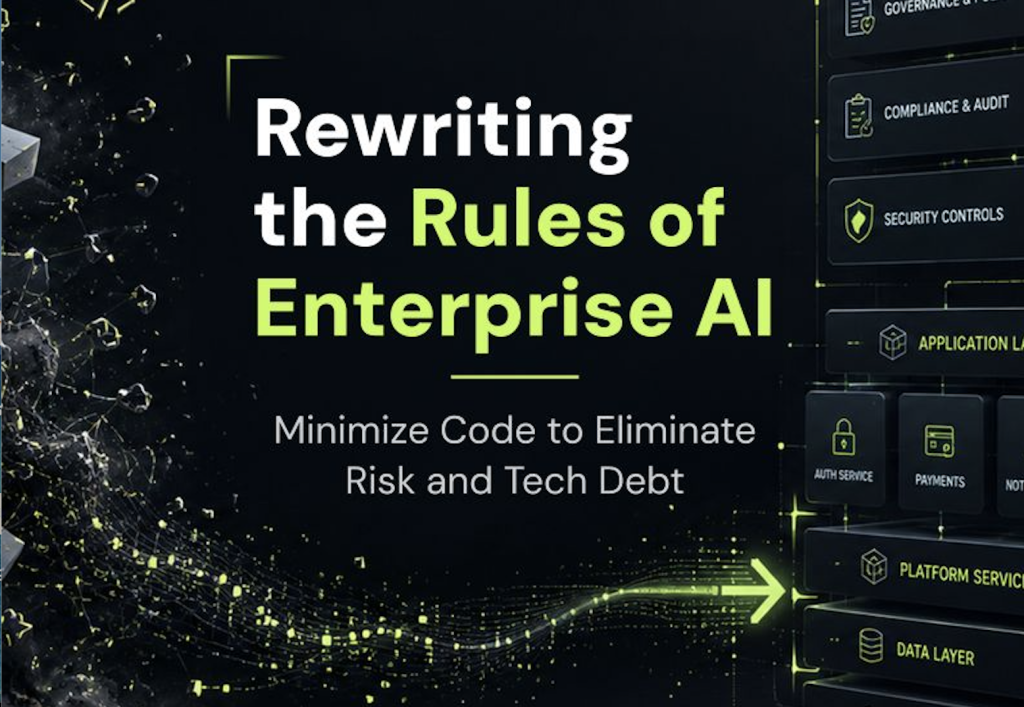
As AI amplifies the technical debt crisis at an unprecedented scale, the winners will be the organizations that replace code generation with architectural discipline.
By Gary Hoberman, Founder & CEO, Unqork
Some creators of the agentic-AI craze are suddenly blowing the whistle, and frankly, I’m not surprised. The Wall Street Journal’s recent story on the rise of “vibe slop” in the enterprise confirms exactly what we have been warning leaders about—long-term operational risk, chaos, and paralysis.
And the consensus on vibe coding is building. Forbes, CIO, and industry groups have all reported on the risks recently.
Yet, the code-generation approach is currently at the top of the docket for so many large enterprises and startups alike. I get it. Speed is great. But at what cost?
Whether written by the best engineer in the world or the most advanced model, huge amounts of new code massively increase a company’s surface area—and exponentially increases costs, security risks, and ultimately long-term competitive disadvantage.
How AI Code Generation Compounds the Maintenance Crisis
As a former Global Fortune 50 CIO, I know the old reality all too well: 80% of IT budgets go straight into maintaining legacy code and digging out of technical debt.
Today, tech giants brag that “75% of new code is AI-generated.” But generating raw code 10x faster doesn’t solve a software problem; it multiplies it.
Consider a simple security exercise:
If you ran the latest AI foundational model against your company’s current codebase, I guarantee you would find vulnerabilities across every application. Even if your company stops innovating entirely for the next six months to fix those high-level gaps, running that scan again will still yield 100% vulnerabilities.
Why? Because hackers never stop evolving, and the underlying code’s runtimes themselves are inherently vulnerable, even if the generated code is “perfect.”
Furthermore, language-based software—whether written in Java, Python, or English—is incredibly brittle. It is impossible to safely change a line of code in production without understanding the greater context of the entire application.
Why LLMs Can’t Be the Only Solution to the Problem
Why does this breakdown happen? Because Large Language Models (LLMs) are probabilistic engines. They use a combination of statistical models, probability distributions, and training data to predict the best possible outcome. However, highly regulated sectors like banking, insurance, and healthcare demand deterministic execution—100% predictable, repeatable, and traceable outcomes.
You cannot run a compliance runbook, a suitability process, or an underwriting engine on a guess.
But when an AI agent hits a gap in institutional knowledge, it doesn’t stop; too often it hallucinates a plausible-looking, unvalidated solution.
By contrast, deterministic AI follows strict, hard-coded rules that ensure the identical output for a given input.
The Solution: Managed Intelligence That Puts Architecture And Reuse At The Forefront
The answer is not to generate more code faster using probabilistic models. The answer is to create an architecture that allows AI models to operate inside deterministic boundaries.
By anchoring AI to a governed component architecture, enterprises can unlock a new paradigm: infinite AI-velocity operating inside an unyielding boundary of security, compliance, and control.
Instead of generating thousands of untraceable lines of untraceable Python or Java rapidly increasing tech debt, highly regulated firms need to take a managed intelligence approach. By building with pre-vetted, reusable, and governed components, enterprises can scale their applications safely while maintaining strict cost efficiency—not just for building a new application but over their lifecycle.
In the ideal world, the LLM agents can still interpret intent, reason across context, and propose actions. But before those actions affect core systems, they pass through deterministic controls that enforce enterprise policies, permissions, compliance requirements, security standards, and audit rules.
A New Mandate for Corporate Boards
We must fundamentally change how we measure value in the AI era. Success is no longer about how many times an employee prompts a tool.
- Corporate boards should consider auditing the total number of lines of code in production and the annual cost required to maintain them. The goal: the less code, the better.
- Leaders should be paid not by headcount or tokens used but by how they are able to combine both human and AI resources to run their function as efficiently and effectively as possible.
The Wild West era of uncontrolled vibe coding is hitting its natural limit. True tech leadership means stepping away from chaotic code generation and building an infrastructure designed for long-term value and impact.