
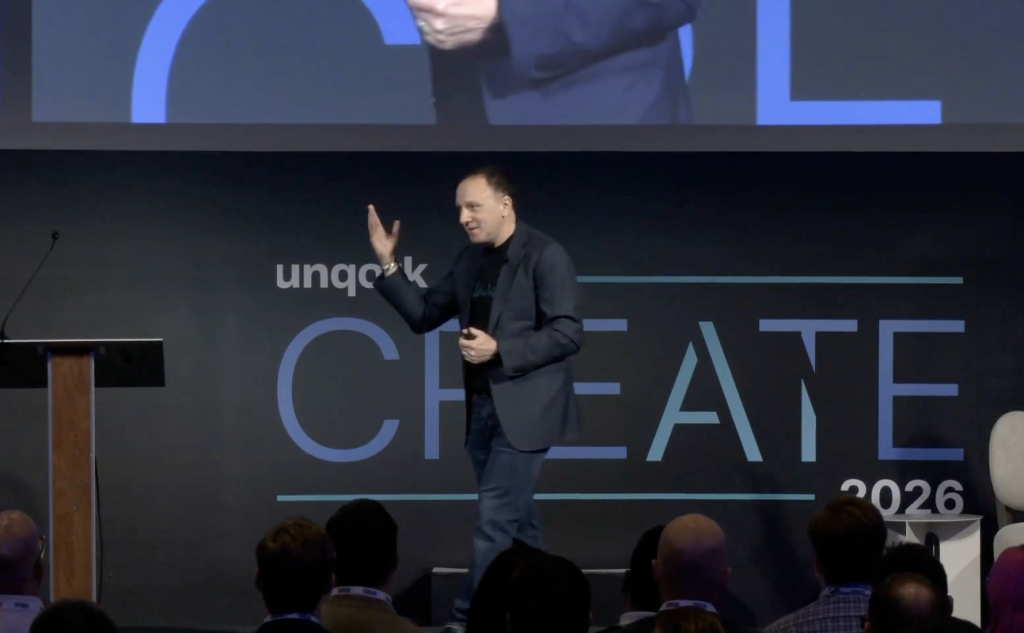
While the industry races to generate more code with AI, Unqork’s Gary Hoberman and Dr. David Ferrucci charted a new path at Unqork CREATE 2026.
At CREATE, Unqork’s Gary Hoberman, Founder and CEO, and Dr. David Ferrucci, Chief Technology and AI Officer, unveiled the most significant evolution of the Unqork platform to date: UnqorkAI.
- The Challenge: In the opening keynote address, Hoberman laid out the biggest challenge facing technology leaders today: AI is generating code far faster than organizations can govern, maintain, and secure it.
- The Solution: Next, Ferrucci introduced UnqorkAI and explained why Unqork’s Smart Component architecture solves this challenge, unlocking the power of LLMs while ensuring requirements are mapped to deterministically configured, proven smart components.
- UnqorkAI in Action: Four Unqork engineers demonstrated the power of UnqorkAI in action.
The Challenge: When More Code Creates More Complexity
Gary Hoberman opened the keynote by reflecting on a lesson that shaped both his career and the founding of Unqork. When he was a young engineer, a seemingly routine infrastructure change triggered failures across hundreds of applications.
The experience exposed a fundamental reality of enterprise software: every line of code creates long-term maintenance obligations.
As Hoberman explained, this is the same challenge he set out to solve when he founded Unqork—to enable enterprises to build applications quickly without writing or generating code.
Today, generative AI promises unprecedented development speed by producing code on demand, but in many cases it accelerates the creation of technical debt, increases governance challenges, and introduces new operational risks, Hoberman said.
“The thing about AI-generated code is, the model owns the logic. The model is generating code. And your best developers become nothing but janitors to clean it up,” Hoberman explained.
The problem is familiar. The scale is new.
And Unqork’s core component-based architecture, he realized, could uniquely solve for this challenge.
The Solution: Introducing UnqorkAI
Next, Dr. David Ferrucci took the stage to unveil UnqorkAI and explained how it takes a fundamentally different approach.
Yes, UnqorkAI harnesses the power of leading foundational LLMs—but not to generate endless amounts of custom code. Instead, UnqorkAI uses those models, which are probabilistic, to map requirements to deterministically configured, proven smart components.
The result: AI-powered development that combines the flexibility of natural language interaction with the governance, transparency, and control enterprises require.
“At the end of the day, that means less code sprawl, less drift, less risk, and less tech debt,” Ferrucci explained.
Demo 1: Building and Updating with UnqorkAI
Joey Milanes, Principal Engineer at Unqork, demonstrated how UnqorkAI can rapidly turn a comprehensive, highly complex business requirements document into an enterprise-grade application.
But crucially, as he pointed out, the Build Agent doesn’t rush to generate an application with black-box code. It does something better.
It creates a comprehensive, interactive technical blueprint, enabling users to review, refine, and inject human context before a single component is assembled.
He also showed how UnqorkAI can execute via a natural-language prompt, empowering non-technical business analysts to make updates instantly while isolating dependencies to prevent regression risk.
Demo 2: The Power of Smart Components
Next, Michael Duke, Senior Engineering Manager at Unqork, showcased the power of Smart Components. To do so, he replaced a legacy operational activity grid with a highly interactive, Excel-like data table—all using a single conversational prompt.
But the real value of Smart Components is the fact that deep engineering optimizations are automatically baked into the component, from UI virtualization and data sanitization to industry-grade ARIA accessibility tags.
And with a click, users can enable reuse, so that UnqorkAI can intelligently surface the component for other team members to use, enabling reuse and eliminating duplicative development efforts.
Demo 3: Enterprise-Grade Performance at Scale
Alex Vanston, Principal Engineer at Unqork, debunked the myth that visual component reusability comes at the expense of speed.
He demonstrated custom UnqorkAI logic transformations processing 50,000 complex compliance records in under 100 milliseconds—exactly one-tenth of a second—and scaling seamlessly to process millions of rows.
Demo 4: Keeping Applications Optimized Over Time
Kristen Stilwell, Director of Applied Reference Engineering at Unqork, addressed long-term software lifecycles by running an automated UnqorkAI health check on a legacy application.
As she showed, UnqorkAI detected a hidden, critical performance bottleneck and automatically deployed a new Smart Component to solve the issue.
Finally, she demonstrated how automated end-to-end testing and immediate checkpoint reversion controls allow teams to confidently modernize legacy software assets without unexpected downstream issues.
What’s Next for UnqorkAI
Looking beyond the platform’s upcoming summer launch, Dr. Ferrucci previewed an ambitious roadmap for future capabilities, including:
- Portfolio-wide application governance
- A centralized observability hub for real-time runtime tracing
- An AI-first collaborative data schema experience
- Unqork on the Edge, so enterprises can deploy the Unqork platform within their private corporate infrastructure.
See watch the full video or see more content from Unqork Create 2026