
The agentic era threatens to undermine the foundational contract of predictability enterprises require. Ferrucci’s Managed Intelligence framework offers a way to rebuild it.
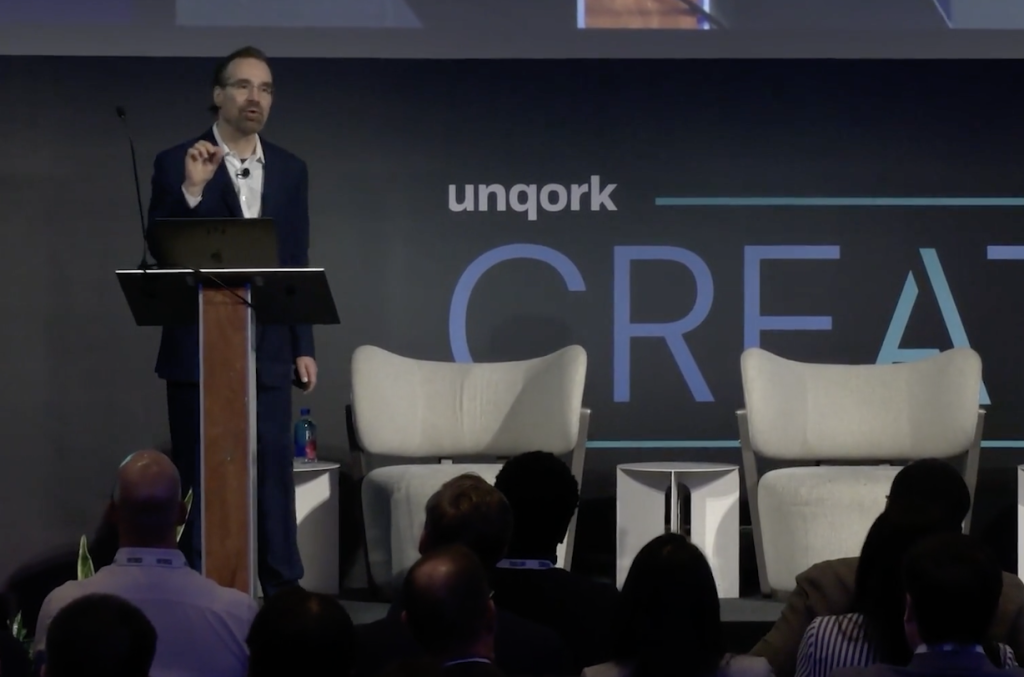
At Unqork CREATE 2026, Dr. David Ferrucci, Chief Technology and AI Officer at Unqork, took a step back to consider the fundamental shift from AI that accelerates software creation to AI as an autonomous decision-maker—and why enterprise leaders must ask themselves a critical:
How can we trust autonomous agents that bypass the traditional software lifecycle entirely?
To make it happen, Ferrucci proposed a new paradigm called Managed Intelligence—the architectural approach on which UnqorkAI is built.
Breaking the Deterministic Contract
Ferrucci, who led the team that created IBM Watson, grounded his talk in a history of enterprise computing. For decades, he explained, corporate infrastructure thrived on a strict contract: deterministic execution. Computers did exactly what they were programmed to do—no more, no less.
In the 1950s, computer scientists experimented with “self-modifying code,” but engineers and business leaders swiftly shut the effort down because it was impossible to audit or predict outcomes.
By contrast, the generative AI models that power many AI development tools rely on probabilistic execution, drawing from massive datasets to make educated guesses and fill in missing details.
Even a few years ago, the corporate tolerance for AI unpredictability was zero. Ferrucci shared an anecdote from his time at Elemental Cognition, where a major travel client demanded that every single phrase their new customer service chatbot might say be pre-approved by corporate legal.
The Danger of Confident Hallucination
Ferrucci explained that the very trait that makes autonomous agents powerful—making educated guesses and filling in missing details—is what makes them dangerous to core, enterprise operations.
The problem isn’t simply that large language models hallucinate. It’s that they do so with absolute authority. An agent can seamlessly convert an incorrect conclusion into a confident action, propagating an error across an entire enterprise ecosystem as if it were governed truth.
Furthermore, Ferrucci warned that piling more prompts onto a system will not fix a probabilistic process. It simply results in invisible assumptions, duplicated logic, and policy drift.
Introducing Managed Intelligence
For regulated environments like finance or healthcare, where tolerance for error is effectively zero, Ferrucci proposed a new paradigm called Managed Intelligence—the architectural approach on which UnqorkAI is built.
Instead of allowing probabilistic agents to interact directly with core enterprise systems, Managed Intelligence introduces a dedicated control plane that provides active, real-time governance for agentic execution.
“This control plane evaluates proposed actions against enterprise invariants—the critical things your business cannot get wrong: policies, formulas, business rules, data constraints, compliance requirements, and operational controls,” Ferrucci explained.
If an agent proposes an action that violates an invariant, the deterministic layer blocks or corrects it instantly using hard rules, rather than relying on a probabilistic guess.
They Key Takeaway
Ferrucci closed the session with a clear mandate for business leaders. Agents are here to stay, and enterprises should absolutely embrace them to accelerate global automation.
However, true competitive advantage will belong to organizations that understand when autonomous agents are appropriate and when deterministic systems must remain in control.